
How to Select the Right Liquid Cold Plate for Your High-Power AI Server Cooling System
How to Select the Right Liquid Cold Plate for Your High-Power AI Server Cooling System
As AI model training and high-performance computing push chip power densities to unprecedented levels, effective thermal management has become the critical bottleneck for system reliability and performance. Liquid cooling, particularly using advanced Liquid Cold Plates, is no longer a luxury but a necessity for modern data centers and AI server racks. With various technologies like Brazed Cold Plates, FSW Cold Plates, and Die Cast Cold Plates available, selecting the optimal solution can be daunting. This guide will walk you through the key considerations and steps to choose the perfect liquid cooling plate for your demanding AI cooling application.
Step 1: Define Your Thermal and Physical Requirements
Before diving into product types, clearly outline your system's needs. This foundational step dictates all subsequent choices.
- Heat Load (Q): What is the total power dissipation (in Watts) of the component(s) you need to cool? For AI server CPUs/GPUs, this can range from 350W to over 1000W per chip.
- Target Component Temperature (Tj or Tcase): What is the maximum allowable temperature for reliable operation? Exceeding this limit risks throttling or failure.
- Available Coolant Temperature (Tcoolant,in): What is the temperature of the coolant supplied to your cold plate? This defines your starting point for heat exchange.
- Flow Rate & Pressure Drop: What are the capabilities and constraints of your facility's cooling distribution unit (CDU) or pump? A high-performance cold plate is useless if your system can't provide the required flow.
- Physical Envelope: What are the spatial constraints? Consider the footprint, height (z-stack), and any obstructions around the heat source.
- Interface & Attachment: How will the cold plate mount to the component? Consider bolt patterns, mounting pressure, and the need for thermal interface materials (TIM).
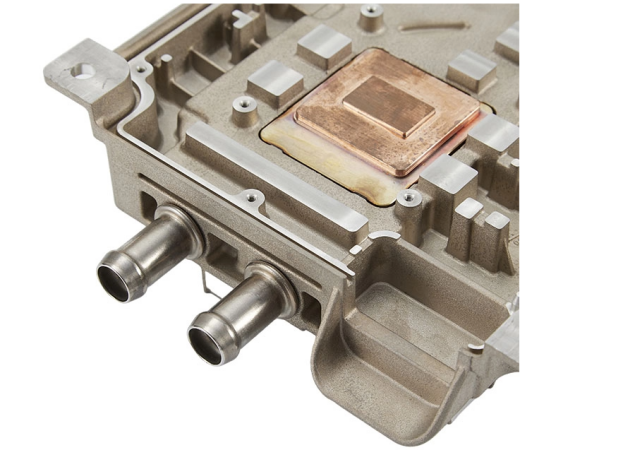
High-density AI servers demand cold plates with excellent thermal conductivity and structural integrity, like the Die Cast Cold Plates from Winshare Thermal.
Step 2: Understand the Core Liquid Cold Plate Technologies
Different manufacturing processes yield cold plates with distinct performance, cost, and application profiles. Here’s a breakdown of the most common types relevant to high-power electronics and water cooling systems.
A. For Maximum Performance & High Heat Flux: Brazed & FSW Cold Plates
When you need the best possible heat transfer from a concentrated heat source.
- Brazed Cold Plates: Constructed by brazing complex internal fin structures between two metal plates. They offer very high surface area for heat exchange, excellent thermal performance, and can handle high pressures. Ideal for laser diodes, power converters, and high-flux IGBT modules. Winshare Thermal utilizes advanced vacuum brazing for leak-proof, robust assemblies.
- FSW (Friction Stir Welded) Cold Plates: Created by using a non-consumable tool to friction-weld internal channels. This process produces a monolithic, leak-tight structure with no filler material. They are known for high reliability, excellent thermal conductivity (as there's no braze alloy barrier), and are often lighter. Perfect for aerospace, defense, and applications where weight and ultimate reliability are critical.
B. For Large Surface Areas & Cost-Effective Cooling: Embedded Tube & Extruded Plates
When cooling distributed heat sources or managing budgets on volume projects.
- Embedded Tube Cold Plates: A coolant tube is pressed or machined into a groove within a metal baseplate and then bonded (often with epoxy or soldered). This offers a good balance of performance and cost for applications like energy storage system battery cooling, industrial power supplies, and certain IGBT modules. They are highly customizable in shape.
- Extruded Cold Plates: Made by pushing heated aluminum through a die to create long profiles with internal channels. Very cost-effective for high-volume production. Thermal performance is good for moderate heat loads, but design flexibility is limited to the extrusion profile. Common in LED lighting arrays and some power electronics.
C. For Advanced Thermal Challenges: Die Cast, Deep Hole Drilled & Micro/Jet Cooling
Pushing the boundaries of thermal management for next-generation tech.
- Die Cast Cold Plates: Molten metal (typically aluminum) is injected into a mold under high pressure. This allows for complex 3D shapes with integrated mounting features, manifolds, and connectors in a single part. Excellent for high-volume production of enclosures with integrated cooling, such as for AI server trays or automotive power electronics. Winshare Thermal's die casting capabilities enable highly integrated thermal solutions.
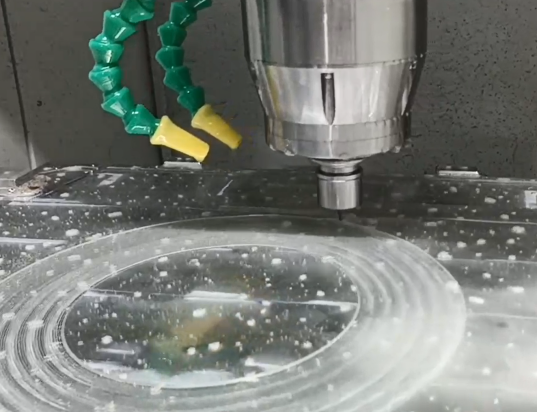
- Deep Hole Drilled Cold Plates: Created by drilling long, straight or intersecting coolant passages directly into a solid metal block. Offers tremendous design freedom for irregular heat source layouts and can achieve very high structural integrity. Ideal for custom industrial machinery, large format laser cooling, and specialized test equipment.
- Micro Channel Cooling & Jet Cooling: These are advanced internal designs within a cold plate. Mirco channel cooling uses numerous tiny channels to drastically increase surface area and heat transfer coefficient. Jet cooling impinges coolant directly onto the back of the heated surface for extreme heat flux removal. Both are used in cutting-edge applications like high-power laser diodes and advanced semiconductor testing.
Step 3: Evaluate Material and Fluid Compatibility
The choice of material impacts corrosion resistance, weight, thermal performance, and cost.
- Aluminum: The most common choice. Lightweight, good thermal conductivity, and cost-effective. Compatible with deionized water or water/glycol mixes. Must be protected from galvanic corrosion if connected to dissimilar metals in the loop.
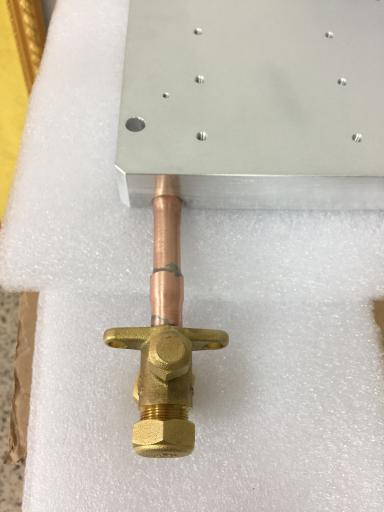
- Copper: Superior thermal conductivity (nearly double that of aluminum). Used for the highest performance demands. Heavier and more expensive. Often used for the base where the chip attaches, with aluminum for the housing.
- Stainless Steel: Used for exceptional corrosion resistance or high-pressure applications (e.g., in certain industrial or marine environments). Thermal conductivity is poorer, so design must compensate.
- Coolant: Deionized water offers the best heat transfer but requires careful loop management to prevent biological growth or corrosion. Water/glycol mixes (e.g., 50/50) provide freeze protection and some biocidal properties but reduce thermal performance slightly. Special dielectric fluids are used for direct-to-chip immersion cooling.
Step 4: Partner with a Qualified Manufacturer for Design & Prototyping
This is where a partner like Winshare Thermal becomes invaluable. A reputable manufacturer doesn't just sell a product; they co-engineer a solution.
- Share Your Requirements: Provide the data from Step 1 to their engineering team.
- Design Support: They should perform thermal and fluid dynamics simulations to model performance and optimize the internal channel design (micro channel cooling patterns, jet arrays, etc.) and manifold design for even flow distribution.
- Prototype and Test: Insist on a functional prototype. Winshare Thermal, with its in-house heat transfer lab, can build and test prototypes to validate thermal performance and pressure drop against your specs.
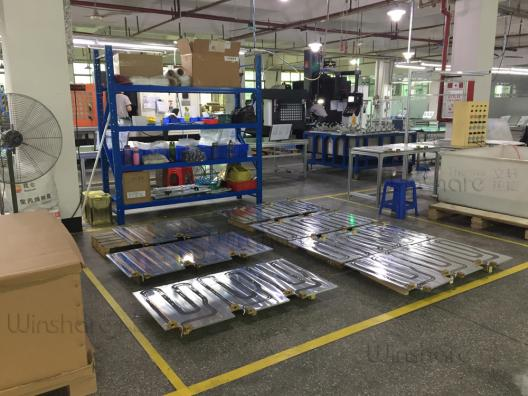
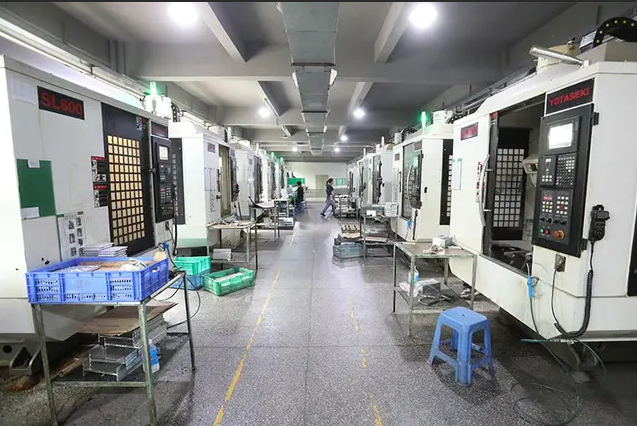
- Manufacturing Audit: Consider their capabilities. A tour of their production workshop reveals their commitment to quality. Winshare's facilities, as seen below, are equipped for precision manufacturing.
Step 5: Verify Quality, Compliance, and Long-Term Support
Before finalizing your selection, ensure the supplier meets global standards and can support you throughout the product lifecycle.
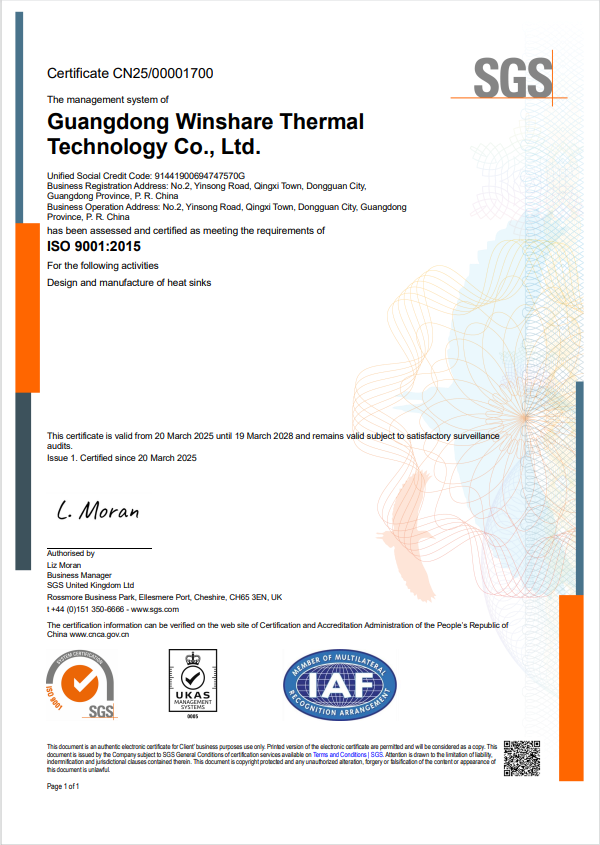
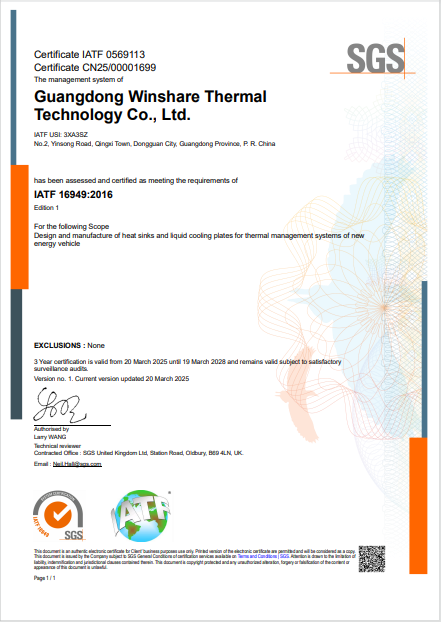
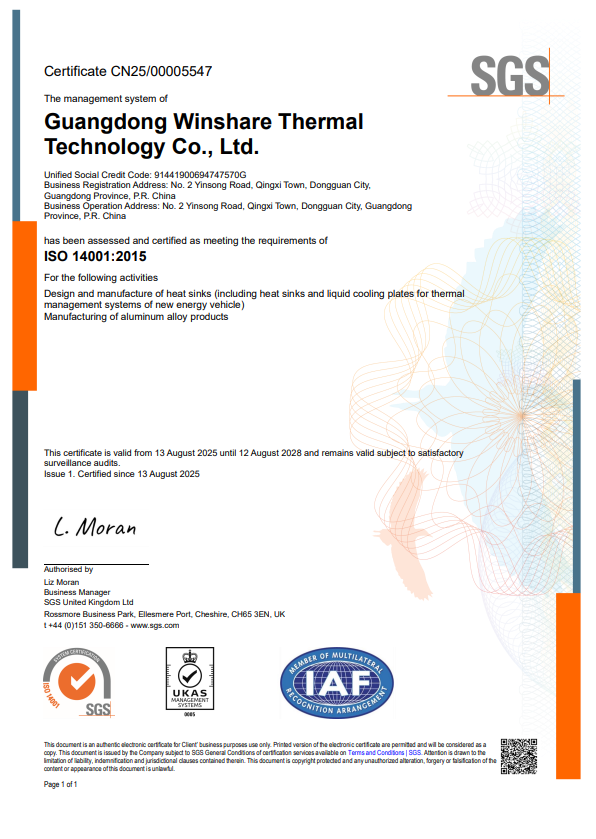
- Certifications: Look for ISO 9001 for quality management and IATF 16949 if supplying to the automotive industry. Winshare Thermal holds multiple certifications, demonstrating a systemic approach to quality and environmental responsibility.
- Leak Testing: Every liquid cooling plate must undergo 100% leak testing (e.g., helium mass spec testing) before shipment.
- After-Sales & Customization: Can they provide ongoing technical support? Do they offer full customization, from Brazed Cold Plates to Deep Hole Drilled Cold Plates, to meet future design changes?
Conclusion: Making an Informed Decision for AI Cooling
Selecting the right Liquid Cold Plate is a systematic process that balances thermal performance, mechanical constraints, cost, and reliability. For the intense demands of AI cooling, technologies like high-performance Brazed or FSW Cold Plates are often the starting point. Partnering with an experienced and certified manufacturer like Guangdong Winshare Thermal Technology Co., Ltd. ensures you get not just a component, but a validated thermal solution backed by rigorous R&D and quality systems.
Founded in 2009 and committed to being a leader in new energy thermal management, Winshare Thermal provides comprehensive water cooling solutions. With capabilities spanning from Embedded Tube Cold Plates for energy storage to advanced Die Cast Cold Plates for AI servers, they guide customers from concept to production. Contact their engineering team today to discuss your specific liquid cooling plate requirements.
Contact Winshare Thermal for Your Cooling Solution:
Phone/WhatsApp/WeChat: +86 18025912990
Email: wst01@winsharethermal.com
Website: https://www.winsharethermalloy.com
Address: No.2 Yinsong Road, Qingxi Town, Dongguan City, Guangdong Province, China 523640
Have Questions or Need More Details?
Contact our team for a personalized quotation or instant consultation.
Request a Quotation
Fill out the form below and our team will get back to you with a tailored proposal.
WhatsApp Direct Chat
Prefer to chat in real-time? Message us on WhatsApp for instant assistance & quick answers.
- Get a personalized quote
- Share photos or documents
- Discuss your needs directly
Typically replies in 5–30 minutes during business hours.