
Cost-Effective Liquid Cold Plates: How Winshare Thermal Balances Quality and Savings
In the high-stakes world of power electronics—from AI servers to EV traction inverters—thermal management is no longer a secondary concern. It is a primary determinant of system reliability, performance, and lifespan. Yet for procurement professionals and engineering managers, the perennial challenge remains: how to source liquid cold plates that deliver uncompromised thermal performance while staying within budget? This guide, built on decades of industry experience and manufacturing data from Winshare Thermal (winning supplier since 2009), provides a structured framework to achieve that balance.
Defining the Core Problem: Cost vs. Quality in Liquid Cold Plate Sourcing
The procurement paradox for liquid cold plates is acute. On one hand, cutting-edge applications like 800W+ AI processors and 500kW liquid-cooled energy storage systems demand near-perfect thermal performance—measured in low thermal resistance (<0.05 °C·cm²/W) and high-pressure capacity (>10 bar). On the other, global competition pressures OEMs to reduce BOM costs by 15–25% year over year. The result? Buyers often fall into two traps:
- Over-specification: Choosing premium brazed or FSW cold plates for applications that could use more cost-effective die-cast or extruded solutions.
- Under-investment: Opting for the cheapest supplier without verifying manufacturing capabilities, leading to higher defect rates, warranty claims, and total cost of ownership (TCO).
The key is not to choose between quality and cost, but to align application requirements with the optimal manufacturing process. This is where a systematic supplier evaluation—focused on process portfolio, quality certifications, and engineering support—becomes critical.
Industry Background: Why Liquid Cold Plate Costs Vary Dramatically
Liquid cold plates are not commodity items. Their cost is driven by three fundamental factors:
| Process Type | Relative Cost (1x = lowest) | Typical Application | Thermal Performance (Rth) |
|---|---|---|---|
| Embossed / Brazed Cold Plates | 2.5x – 4x | High-power IGBT, traction motors, AI clusters | 0.02–0.04 °C·cm²/W |
| FSW Cold Plates | 3x – 5x | Lightweight EV battery packs, aerospace | 0.015–0.03 °C·cm²/W |
| Deep Hole Drilled Cold Plates | 4x – 6x | Custom-shaped heat sources, laser diodes | 0.01–0.025 °C·cm²/W |
| Extruded Cold Plates | 1x – 1.5x | Low-to-medium power converters, telecom | 0.05–0.10 °C·cm²/W |
| Die Cast Cold Plates | 1.2x – 2x | Mass-produced AI servers, consumer electronics | 0.06–0.12 °C·cm²/W |
| Embedded Tube Cold Plates | 2x – 3x | Energy storage, industrial inverters | 0.03–0.06 °C·cm²/W |
Understanding these cost-performance trade-offs is the first step. The second is identifying a supplier that can offer multiple manufacturing processes under one roof, enabling unbiased technology selection rather than a one-size-fits-all recommendation.
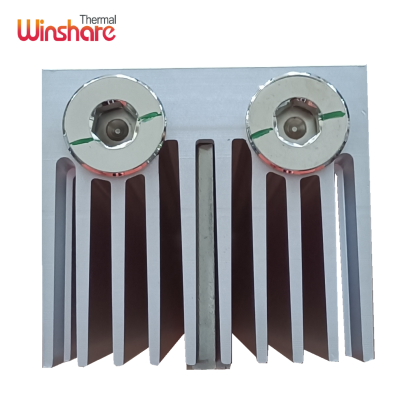
Extruded cold plates offer the lowest entry cost per watt cooled, ideal for applications where thermal budget allows slightly higher thermal resistance.
Detailed Solution: A Step-by-Step Framework for Cost-Effective Procurement
Step 1: Define Your Thermal Requirements Accurately
Before comparing prices, quantify your needs: heat flux (W/cm²), maximum junction temperature, coolant inlet temperature, flow rate, and allowable pressure drop. Use simulation tools or request a thermal design review from your supplier. Winshare Thermal offers free engineering consultations (contact: wst03@winsharethermal.com) to help you avoid over-specification.
Step 2: Match Application to the Most Cost-Effective Manufacturing Process
Refer to the table above. For example, an AI server with 600W TDP and moderate space constraints can often be cooled by a die-cast cold plate (aluminum, integrated fins) at 40% lower cost than a brazed copper solution. Winshare Thermal’s die-cast cold plates (picture below) are designed for high-volume, low-cost production while maintaining thermal performance suitable for AI accelerators.
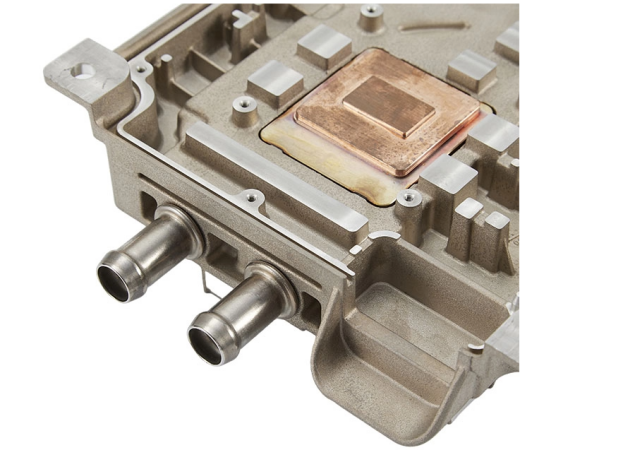
Die-cast cold plates provide a balance of thermal performance and low piece price, perfect for high-volume AI server deployments.
Step 3: Evaluate Supplier Quality Certifications & Manufacturing Capability
Quality assurance is non-negotiable. Look for suppliers certified to ISO 9001:2015, IATF 16949:2016, ISO 14001:2015, and ISO 45001:2018. Winshare Thermal holds all these certifications, demonstrating a culture of continuous improvement and robust process control. Factory tours and audits are welcomed; the company’s 36,000+ sqm facility in Dongguan houses dedicated production lines for brazing, FSW, die casting, and extrusion.
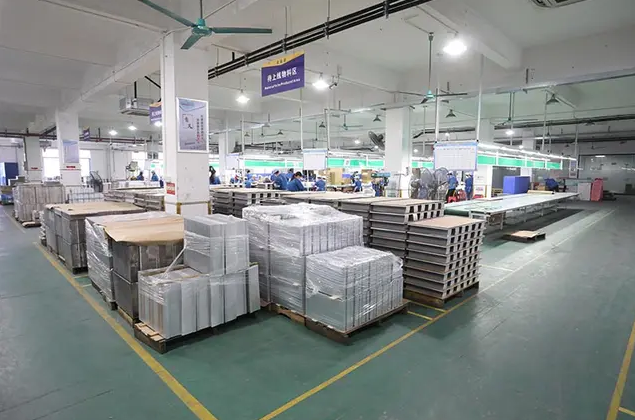
Winshare Thermal’s in-house workshop enables end-to-end quality control and faster time-to-market.
Step 4: Leverage Design-for-Manufacturing (DFM) Expertise
Up to 30% of cold plate cost can be eliminated through smart design modifications—such as reducing fin density, standardizing interface dimensions, or choosing a more castable alloy. Winshare Thermal’s engineering team, backed by partnerships with South China University of Technology, provides DFM reviews early in the product cycle. This proactive approach prevents costly rework and tooling changes.
Step 5: Compare Total Cost of Ownership (TCO), Not Unit Price
A low unit price often hides higher costs from:
- Shipping delays (long lead times)
- Rejected shipments (poor quality control)
- Warranty claims (field failures)
- Limited technical support (increased time-to-market)
Winshare Thermal operates with ISO 9001:2015 standards, maintains on-time delivery rates above 98%, and provides dedicated engineering support from concept to production. They integrate seamlessly into customers’ supply chains, reducing procurement risk.
Use Case: Cost Reduction Without Sacrificing Performance in Energy Storage Cooling
A leading energy storage system integrator needed to reduce cooling cost by 20% while maintaining junction temperatures below 85°C for IGBT modules in a 1MW containerized system. Initially specifying a brazed copper cold plate, they worked with Winshare Thermal to evaluate an embedded tube aluminum cold plate alternative. The result: a 35% cost saving, only 7% higher thermal resistance (still within spec), and a 4-week shorter lead time. The embedded tube design (pictured below) also offered better corrosion resistance for long-life applications.
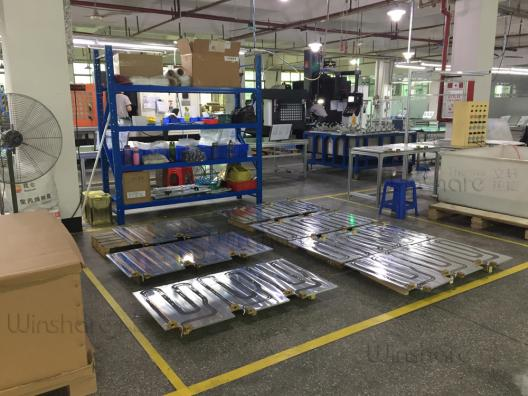
Embedded tube cold plates provide a cost-effective alternative to brazed solutions for medium-power IGBT and ESS applications.
Frequently Asked Questions (FAQ)
Q: What is the cheapest type of liquid cold plate?
A: Extruded cold plates generally have the lowest material and tooling cost. However, they offer limited geometric complexity and thermal performance. For most industrial applications, die-cast or embedded tube cold plates provide the best value-to-performance ratio.
Q: How can I verify a supplier’s quality without visiting the factory?
A: Request ISO 9001 and IATF 16949 certificates, ask for test reports (pressure decay, flow performance, thermal resistance), and check references. Winshare Thermal provides all certificates on request (see samples below).
Q: What is the typical lead time for custom liquid cold plates?
A: For standard designs (extruded or die-cast), 2–4 weeks. For complex FSW or deep-hole drilled designs, 6–8 weeks. Winshare Thermal’s DFM service can often reduce lead times by optimizing the design for existing tooling.
Q: Can I combine multiple cold plate technologies in one system?
A: Yes. For example, using a lower-cost extruded plate for auxiliary electronics and a brazed plate for the main heat source. Winshare Thermal offers a full portfolio to enable hybrid cooling architectures.
Winshare Thermal’s Quality Credentials
As a trusted partner across ICT, photovoltaic inverters, wind power converters, EV traction, and energy storage, Winshare Thermal’s quality management is underpinned by:
- ISO 9001:2015 – Quality management system
- IATF 16949:2016 – Automotive-grade quality
- ISO 14001:2015 – Environmental management
- ISO 45001:2018 – Occupational health & safety
- Intellectual Property Compliance Certification
These certifications ensure consistent manufacturing excellence and global compliance.
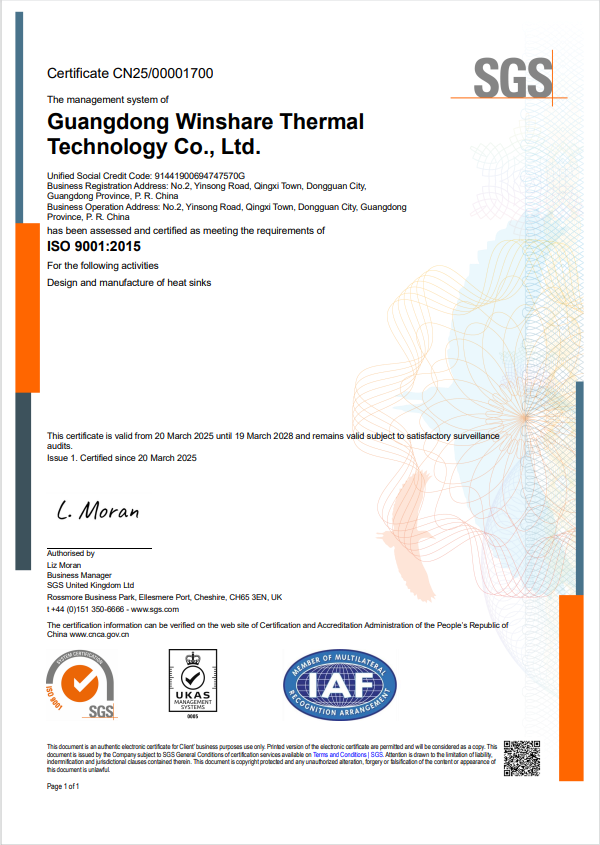
ISO 9001:2015 certification demonstrates Winshare Thermal’s commitment to quality management and continuous improvement.
Conclusion: Smart Procurement = Aligned Technology + Trusted Partner
Controlling liquid cold plate costs without compromising quality is achievable when you apply a systematic approach: understand your true thermal requirements, select the appropriate manufacturing process, partner with a certified supplier offering multiple technologies, and analyze total cost of ownership.
Winshare Thermal (founded 2009, China) stands ready to help you navigate this trade-off with its broad portfolio—brazed, FSW, embedded tube, die cast, extruded, deep hole drilled—and in-house engineering capability. Contact their team today to request a cost optimization proposal:
📞 Tel/WhatsApp: +86 18025912990 (Alisa)
📧 Email: wst01@winsharethermal.com or wst03@winsharethermal.com
🌐 Website: https://www.winsharethermalloy.com
📍 Address: No.2 Yinsong Road, Qingxi Town, Dongguan City, Guangdong Province, China 523640
Have Questions or Need More Details?
Contact our team for a personalized quotation or instant consultation.
Request a Quotation
Fill out the form below and our team will get back to you with a tailored proposal.
WhatsApp Direct Chat
Prefer to chat in real-time? Message us on WhatsApp for instant assistance & quick answers.
- Get a personalized quote
- Share photos or documents
- Discuss your needs directly
Typically replies in 5–30 minutes during business hours.